Palmetto PeptidesPALMETTO PEPTIDES
Research Grade QualityFast USPS Priority ShippingBPC-157 · TB-500 · Semaglutide · TirzepatidePremium Peptide StacksThird-Party Tested · COA Verified · Research GradeMade in the USAResearch Grade QualityFast USPS Priority ShippingBPC-157 · TB-500 · Semaglutide · TirzepatidePremium Peptide StacksThird-Party Tested · COA Verified · Research GradeMade in the USA

How to Buy TB-500 Research Peptide Online: Supplier Selection Criteria for Laboratories

Palmetto Peptides Research Team
March 27, 2026

Last Updated: March 19, 2026 | Author: Palmetto Peptides Research Team | Reading Time: ~9 minutes

Research Disclaimer: TB-500 sold by Palmetto Peptides is intended exclusively for in vitro laboratory research by qualified researchers. It is not approved by the FDA for human or veterinary use and should not be purchased for those purposes. All purchasers must confirm research intent and are responsible for complying with applicable laws.


How to Buy TB-500 Research Peptide Online: Supplier Selection Criteria for Laboratories

The research peptide market has grown substantially over the past decade, and with that growth has come significant variation in product quality, documentation standards, and regulatory compliance. Not all TB-500 sold online is created equal, and for researchers whose data quality depends on compound integrity, supplier selection is a decision worth taking seriously.

This guide is written for laboratory researchers and procurement personnel evaluating TB-500 suppliers. It covers the specific criteria that distinguish reputable research compound vendors from those offering products of questionable quality or compliance, the documentation you should expect to receive, the questions worth asking before you order, and the specific red flags that should prompt you to look elsewhere.


Why Supplier Quality Matters for Research Outcomes

The quality of a research peptide directly affects the validity of experimental results. Impurities introduced during synthesis can produce off-target effects in cell assays that are indistinguishable from genuine peptide biology. Inaccurate peptide content claims lead to incorrect concentration calculations and inconsistent dosing across experiments. A compound that has degraded in storage produces data that reflects the biology of degradation products rather than TB-500 itself.

These are not abstract concerns. Published peptide research has identified cases where results could not be replicated across laboratories, with supplier and lot variation as a contributing factor. For your research to be reproducible and publishable, the analytical foundation of your compound needs to be solid.


The Core Criteria: What a Quality TB-500 Supplier Provides

1. Lot-Specific Third-Party Certificate of Analysis

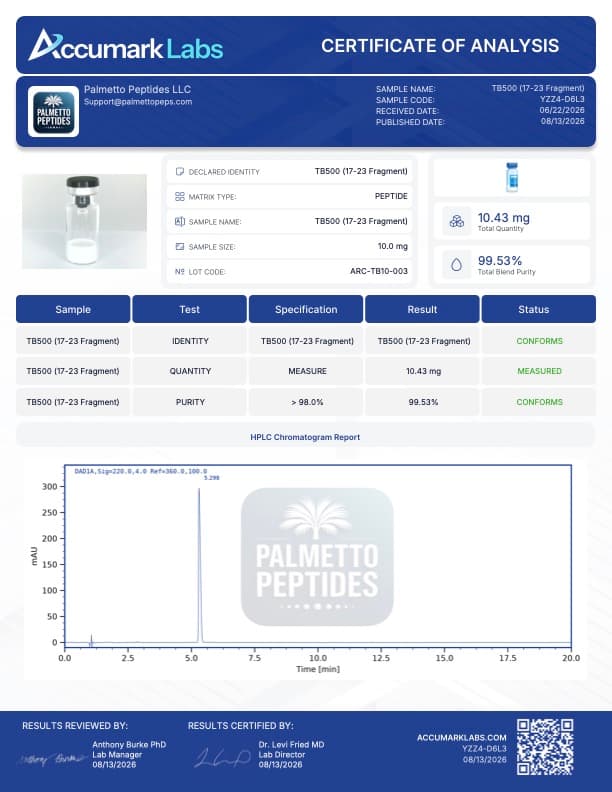
This is the single most important quality indicator, and it should be non-negotiable. A Certificate of Analysis that qualifies a research peptide purchase must:

  • Reference the specific lot number of the product you are receiving (not a generic "representative" CoA)
  • Show HPLC purity data of at least 98%, with chromatographic conditions or a chromatogram
  • Include mass spectrometry identity confirmation showing an observed molecular weight consistent with Ac-LKKTETQ
  • Identify the testing laboratory by name (third-party independent testing provides stronger assurance than supplier self-testing)
  • Include the test date

Some suppliers also provide amino acid analysis (AAA) data confirming peptide content percentage, and endotoxin testing results for cell culture-grade material. These additions are valuable for researchers conducting sensitive cell-based work.

Ask for the CoA before you order if it is not readily available on the product page. Any reluctance to provide lot-specific documentation is a significant concern.

2. Synthesis by Established Methods with Transparent Quality Control

Reputable research peptide suppliers produce TB-500 via solid-phase peptide synthesis (SPPS) using established coupling chemistry and validated purification processes (typically preparative HPLC). They should be able to describe their manufacturing process at a general level and demonstrate that quality control testing is conducted routinely.

What to look for:
- Description of synthesis methodology on product or company pages
- Statement of purification method used
- Quality control testing performed before release
- Batch rejection criteria (indicating that substandard batches are not simply sold at reduced price)

3. Clear Research-Only Language and Regulatory Compliance

Legitimate TB-500 research compound suppliers in the U.S. market their products explicitly for in vitro laboratory research use only. Product pages, labeling, and marketing materials should not contain:

  • Language suggesting suitability for human use
  • Language suggesting suitability for veterinary or animal treatment use
  • Dosing recommendations framed around human or animal body weight for therapeutic purposes
  • Health claims or benefit statements framed as applicable to living subjects

Any supplier whose marketing implies or explicitly suggests human or animal use is operating outside the bounds of legal research compound sales in the U.S. and represents a regulatory compliance concern.

At Palmetto Peptides, all product pages, labeling, and marketing comply with research compound standards. Our TB-500 product page includes full disclaimer language and is structured for qualified researchers.

4. Cold Chain Shipping and Temperature Management

Lyophilized peptides are stable under proper conditions but can be degraded by extended exposure to elevated temperatures during shipping. This is particularly relevant for warm-climate shipping destinations and longer transit times.

Quality suppliers:
- Ship lyophilized peptides with appropriate cold chain management (ice packs or dry ice)
- Include temperature monitoring indicators in shipments
- Provide tracking information to minimize delivery delays
- Have clear policies for products compromised during shipping

5. Transparent Contact Information and Customer Support

Research compound procurement sometimes requires direct conversation about technical specifications, order details, or quality questions. A supplier should be reachable through:

  • A clearly stated physical or operational address
  • Working phone and/or email contact channels
  • Responsive pre- and post-purchase customer support

Anonymous or difficult-to-contact suppliers offer no accountability if quality issues arise. For procurement in institutional research settings, vendor accountability is typically required by institutional purchasing policies.


Red Flags: What to Watch For

Red Flag Why It Matters
Generic or undated CoA without a lot number CoA does not apply to the specific product being sold
Purity claims without supporting analytical data Unverifiable and potentially false
No named testing laboratory on CoA Cannot verify who tested or by what method
Language implying human or veterinary use Legal compliance failure; regulatory risk
No research-only disclaimer Non-compliant with research compound standards
Prices significantly below market rate Often indicates reduced quality standards, different synthesis methods, or lower actual purity
No synthesis or manufacturing information Cannot assess quality process
No response to pre-purchase technical questions Indicates poor customer accountability
Products sold in non-standard vial formats without documentation Suggests repackaging of unknown source material

On Price as a Quality Signal

The cost of manufacturing high-quality research peptides is not trivial. Analytical testing, quality SPPS coupling reagents, preparative HPLC purification, and proper lyophilization equipment all represent real costs that are reflected in pricing. Research-grade TB-500 at 98%+ purity with third-party analytical documentation carries a cost floor below which quality maintenance becomes implausible.

Significant underpricing relative to the market is a meaningful signal. It suggests either that quality standards are compromised somewhere in the process, that purity claims are not substantiated, or that the compound is being sourced from manufacturers whose quality controls are unknown. For researchers who depend on compound integrity for publishable data, the cost of failed experiments always exceeds the cost of quality procurement.


Questions to Ask Before You Buy

If you are evaluating a TB-500 supplier for the first time or considering switching from a current supplier, the following questions provide a useful qualification framework:

  1. Can you provide the lot-specific Certificate of Analysis for the current TB-500 inventory, including HPLC purity and mass spectrometry data?
  2. Is analytical testing conducted by your own laboratory or by an independent third-party analytical facility? Which facility?
  3. What is your standard minimum HPLC purity specification for TB-500?
  4. Do you offer endotoxin testing results for cell culture applications?
  5. How is TB-500 shipped, and what temperature monitoring do you include?
  6. What is your policy if a product is damaged or compromised during shipping?
  7. Is your product manufactured via solid-phase peptide synthesis, and where is synthesis conducted?

Quality suppliers answer these questions directly and completely. Evasive or vague responses to basic quality questions are informative.


Palmetto Peptides: Our Quality Commitments

Palmetto Peptides produces and supplies TB-500 for qualified laboratory researchers with the following standards:

  • Independent third-party analytical testing for every lot
  • HPLC purity verification at 98% minimum
  • Mass spectrometry identity confirmation
  • Lot-specific Certificate of Analysis provided with every order
  • Research-only labeling and marketing in full FDA compliance
  • Cold chain shipping with appropriate temperature management
  • U.S.-based customer support

View our current TB-500 research compound listing and request a CoA directly from the product page.


Frequently Asked Questions

What should researchers look for when buying TB-500 online?
Prioritize lot-specific third-party CoA documentation with at least 98% HPLC purity and mass spectrometry identity confirmation, clear research-only designation, proper cold chain shipping, synthesis by established SPPS methods, and responsive customer support.

Is it legal to buy TB-500 online in the United States?
Yes, as a research compound for qualified laboratory and scientific use. It may not be sold for human consumption or veterinary use. Purchasers are responsible for compliance with applicable regulations.

How do I verify a supplier's CoA is legitimate?
A legitimate CoA contains the specific lot number, named testing laboratory, test date, HPLC purity percentage with analytical conditions, and mass spectrometry identity data. Generic or undated documents without lot-specific information do not verify the product you receive.

Does TB-500 need cold shipping?
Lyophilized TB-500 benefits from cold chain management during shipping. Reputable suppliers include ice packs or dry ice and temperature monitoring. Contact your supplier if significant cold chain compromise occurs during transit.

What are common red flags with TB-500 suppliers?
Purity claims without supporting CoA data, CoAs without lot numbers or named testing labs, language implying human or veterinary use, no research-only disclaimers, significantly below-market pricing, and poor responsiveness to technical questions.


Peer-Reviewed Citations

  1. Esposito S, Deventer M, Osswald S, van Eenoo P. Synthesis and characterization of the N-terminal acetylated 17-23 fragment of thymosin beta 4 identified in TB-500. Drug Testing and Analysis. 2012;4(9):733-738. doi:10.1002/dta.1402

  2. Goldstein AL, Hannappel E, Sosne G, Kleinman HK. Thymosin beta4: a multi-functional regenerative peptide. Basic properties and clinical applications. Expert Opinion on Biological Therapy. 2012;12(1):37-51. doi:10.1517/14712598.2012.634793

  3. Manning MC, Chou DK, Murphy BM, Payne RW, Katayama DS. Stability of protein pharmaceuticals: an update. Pharmaceutical Research. 2010;27(4):544-575. doi:10.1007/s11095-009-0045-6


Author: Palmetto Peptides Research Team | Last Updated: March 19, 2026

Purity Testing Methods | TB-500 Complete Research Guide | Shop TB-500

More Research Articles