Sourcing High-Purity MOTS-c for Research: What Laboratories Should Evaluate in Vendors
This article is part of the Complete MOTS-c Research Guide.
Research Disclaimer: MOTS-c is an investigational research peptide not approved by the FDA for human or veterinary use. This guide is for laboratory procurement professionals and researchers evaluating vendors for legitimate scientific research supply. All MOTS-c products referenced are for laboratory use only.
Sourcing High-Purity MOTS-c for Research: What Laboratories Should Evaluate in Vendors
Last Updated: January 15, 2025
Procurement decisions for research peptides rarely get the same careful attention as experimental design, but they should. The vendor you choose for MOTS-c determines the quality of the compound your experiments depend on, and in peptide research, compound quality is an experimental variable. A poorly sourced peptide can produce irreproducible results, generate misleading data, and waste months of research effort.
This guide is written for laboratory researchers and procurement professionals who are evaluating vendors for high-purity MOTS-c supply. It covers the synthesis, documentation, regulatory, and logistical dimensions of vendor evaluation, and provides a practical framework for making an informed sourcing decision.
The Research Peptide Vendor Landscape
The market for research peptides has expanded significantly over the past decade, driven by growing interest in peptide biology research. This growth has attracted a wide range of suppliers, from well-capitalized, QC-focused companies to small operations with limited analytical capability. The variation in quality between suppliers is substantial.
For a compound like MOTS-c, where the research questions are often mechanistic and the downstream readouts are sensitive (AMPK phosphorylation by Western blot, gene expression by qPCR, glucose uptake assays), the quality of the compound is not a minor concern. Impurities in research peptides have been documented to confound assays in the literature, and replication failures in peptide biology research have sometimes been traced to compound quality differences between laboratories.
This context makes vendor evaluation a scientifically important process, not just an administrative one.
Evaluation Dimension 1: Synthesis Quality and Capability
The primary method for producing synthetic research peptides like MOTS-c is solid-phase peptide synthesis (SPPS). In SPPS, amino acids are added one at a time to a solid resin support, building the peptide chain from the C-terminus to the N-terminus. After synthesis is complete, the peptide is cleaved from the resin and purified.
What Determines SPPS Quality
Reagent grade: The amino acid building blocks used in SPPS are available in various grades. Higher-grade, well-characterized building blocks produce cleaner synthesis with fewer side reactions.
Coupling efficiency: At each amino acid addition step, the coupling reaction must proceed to near-completion. Incomplete coupling produces deletion sequences (peptides missing one or more amino acids) that are structural analogs of MOTS-c and can interfere with or confound assay results.
Purification method: After synthesis, the crude peptide mixture is purified by preparative HPLC, a larger-scale version of the analytical HPLC used for purity testing. The effectiveness of this purification step determines how much of the synthesis byproducts are removed. Multiple rounds of preparative HPLC are sometimes required to achieve 98%+ purity for complex sequences.
Post-purification analysis: After purification, analytical HPLC and mass spectrometry should be run on the final product to confirm purity and identity before release for sale.
Questions to Ask Vendors About Synthesis
When evaluating a MOTS-c vendor, consider asking:
- Where is the peptide synthesized? (In-house or contract synthesis?)
- What grade of amino acid building blocks is used?
- How many purification steps are performed?
- What is the typical coupling efficiency for their synthesis platform?
- At what scale is MOTS-c synthesized?
Vendors who can speak knowledgeably about their synthesis process are more credible than those who cannot.
Evaluation Dimension 2: Quality Documentation
This is the single most important dimension to evaluate and the easiest to assess objectively. A vendor either has adequate documentation or does not.
Certificate of Analysis Requirements
A complete, acceptable CoA for research-grade MOTS-c must include:
Mandatory elements:
- Product name: MOTS-c with full amino acid sequence (MRWQEMGYIFYPRKLR)
- Lot/batch number (unique identifier for this production batch)
- Molecular formula and molecular weight
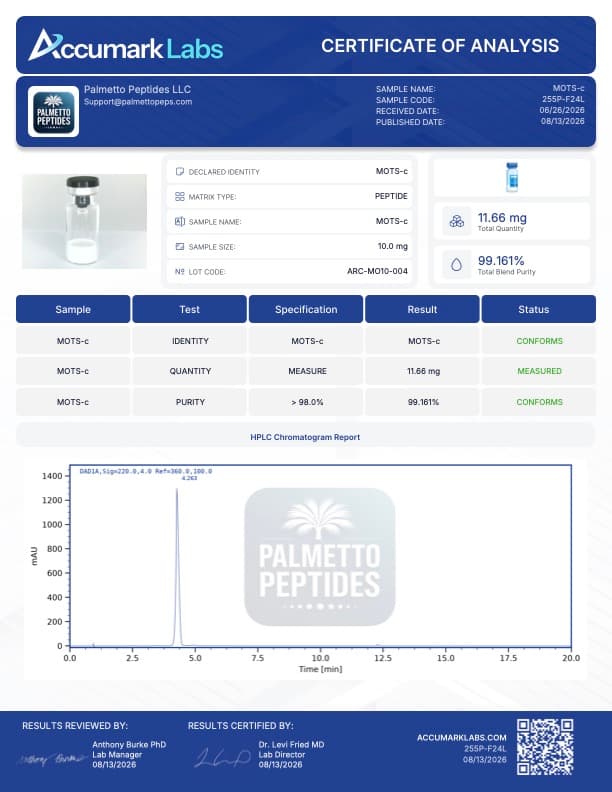
- HPLC purity: percentage value with chromatogram (the actual graphic trace, not just a number)
- Mass spectrometry: observed molecular weight vs. calculated, with acceptable deviation stated
- Appearance: description (e.g., white lyophilized powder)
- Net weight of peptide content
- Storage conditions
- Date of analysis
Strongly preferred additional elements:
- Water content by Karl Fischer titration
- Testing laboratory name and contact
- Endotoxin testing result (essential for in vivo applications)
- Signature or authorization of quality review
Red Lines: Documentation That Disqualifies a Vendor
The following documentation failures should disqualify a vendor from consideration:
- No CoA available at all
- CoA without a batch/lot number (cannot be traced to a specific production run)
- CoA that lists purity without the HPLC chromatogram or without making it available
- CoA without mass spectrometry confirmation
- CoA that appears to be a template with the same information across multiple products (a sign of fabricated or non-specific documentation)
- Purity stated without specifying the testing method
Evaluation Dimension 3: Regulatory and Compliance Positioning
Research-Use-Only Requirements
MOTS-c is not an FDA-approved drug. It is a research compound. Any vendor operating appropriately in this space will clearly label their products as being for research and laboratory use only, with explicit statements that the product is not for human or veterinary consumption.
What to look for:
- Clear "For Research Use Only" or "Not for Human Use" labeling on product pages and vials
- No marketing language suggesting or implying fitness for human research application, anti-aging effects, bodybuilding use, or therapeutic applications
- No implied clinical claims
Red flag: Any vendor marketing MOTS-c for personal or health-related applications is not operating within appropriate regulatory boundaries for research compound supply and should not be trusted for laboratory use.
Legal Status Clarity
In the United States, MOTS-c is legal to purchase and possess for legitimate laboratory research. Vendors should be transparent about the regulatory status of their products and their intended-use positioning. Vendors who are vague, evasive, or contradictory about intended use should be avoided.
Evaluation Dimension 4: Logistical and Operational Capability
Cold-Chain Shipping
Lyophilized peptides are more stable at ambient temperature than reconstituted solutions and can often withstand short-transit shipping (1-3 days) without cold packing. However, for long-distance shipments or hot climates, cold-chain shipping with ice packs or dry ice is preferable to maintain compound integrity.
Questions to ask:
- What shipping methods are available?
- Is cold-chain packaging an option?
- What is the estimated transit time to your location?
- What guarantees or policies exist for shipments damaged in transit?
Availability and Lead Time
MOTS-c should be available in catalog quantities (5 mg, 10 mg, custom) with reasonable lead times. Lead times of 1-2 weeks are typical for custom synthesis; off-the-shelf catalog orders should ship within 1-5 business days for established suppliers.
For research programs requiring continuous compound supply over extended study periods, ask about the vendor's ability to provide matched-lot material (the same batch number across multiple orders) to minimize lot-to-lot variability between experiments.
Custom Synthesis Capability
Some research programs may require MOTS-c variants (truncated sequences, amino acid substitutions, fluorescently labeled MOTS-c for tracking studies). Vendors with in-house synthesis capability or established custom synthesis relationships can accommodate these needs. This is a differentiating factor for more advanced research programs.
Evaluation Dimension 5: Customer Support and Scientific Responsiveness
A vendor serving laboratory researchers should be able to:
- Answer basic technical questions about the compound (molecular weight, recommended storage, typical research concentrations in the literature)
- Provide documentation promptly upon request
- Have a reachable customer service channel with response times under 24 hours for technical inquiries
- Handle order issues, replacements, and custom requests professionally
Testing responsiveness: Before placing a significant first order, consider sending a technical question by email or chat and evaluating the quality and timeliness of the response. A vendor who cannot answer "what is the recommended storage temperature for reconstituted MOTS-c?" competently is probably not well-suited for supplying your laboratory.
Vendor Comparison Framework
Use this framework when comparing MOTS-c vendors side by side:
| Evaluation Criterion | Weight | Vendor A | Vendor B | Palmetto Peptides |
|---|---|---|---|---|
| HPLC purity documented | High | ? | ? | Yes (98%+) |
| Mass spec confirmation | High | ? | ? | Yes |
| Batch-specific CoA | High | ? | ? | Yes |
| Third-party testing | Medium | ? | ? | Yes |
| Research-use-only labeling | High | ? | ? | Yes |
| Cold-chain shipping | Medium | ? | ? | Yes |
| Technical responsiveness | Medium | ? | ? | Yes |
| Price (per mg) | Low-Medium | ? | ? | Competitive |
| Custom synthesis option | Low | ? | ? | Available |
| Endotoxin testing | High for in vivo | ? | ? | Available |
Fill in based on your direct evaluation of competing vendors.
Why Palmetto Peptides for MOTS-c Research Supply
Palmetto Peptides has established its supply standards specifically to meet the documentation and quality requirements of legitimate laboratory research:
Documentation: All MOTS-c orders include batch-specific certificates of analysis with HPLC purity documentation and mass spectrometry confirmation.
Positioning: All products are labeled and marketed for research use only. No products at Palmetto Peptides are marketed for human or personal use applications.
Purity standard: Research-grade MOTS-c is provided at 98%+ HPLC purity minimum, with higher purity available.
Technical support: Our team is available to answer questions about compound handling, research concentrations in published literature, and reconstitution protocols.
For complementary peptide research tools, researchers building out metabolic research programs can explore our full catalog including IGF-1 LR3, BPC-157, NAD+ precursors, and Selank.
Related Research Articles
- How to Buy MOTS-c Research Peptide Online: Supplier Standards for Laboratory Use
- Purity Testing and Quality Standards for Research-Grade MOTS-c Peptide
- Reconstituting and Storing MOTS-c Research Peptide: Best Practices for Lab Experiments
- MOTS-c Peptide: Comprehensive Research Overview
- MOTS-c vs Other Mitochondrial-Derived Peptides: Comparative Analysis in Scientific Literature
Summary
Sourcing high-purity MOTS-c for research requires systematic vendor evaluation across five dimensions: synthesis quality and capability, quality documentation completeness (batch-specific CoA with HPLC and mass spec data as minimum requirements), regulatory compliance positioning (research-use-only with no human use marketing), logistical capability (cold-chain shipping, lead times, lot consistency), and technical responsiveness. Documentation gaps, particularly missing CoAs or CoAs without mass spectrometry confirmation, are disqualifying. Very low pricing should trigger additional documentation requests. The compound quality your laboratory starts with determines the reliability of the results you generate, making vendor selection a scientific decision, not just a procurement one.
Further Reading
For a full overview of MOTS-c mechanisms, research findings, and sourcing guidance, see our Complete Guide to the Research Peptide MOTS-c.
Peer-Reviewed References
- Lee C, Zeng J, Drew BG, et al. The mitochondrial-derived peptide MOTS-c promotes metabolic homeostasis and reduces obesity and insulin resistance. Cell Metabolism. 2015;21(3):443-454.
- International Council for Harmonisation (ICH). Q6B: Specifications: Test Procedures and Acceptance Criteria for Biotechnological/Biological Products. ICH Technical Report; 1999.
- Merrifield RB. Solid phase peptide synthesis. I. The synthesis of a tetrapeptide. Journal of the American Chemical Society. 1963;85(14):2149-2154. (foundational SPPS reference)
- United States Pharmacopeia. USP 2040: Biological Reactivity Tests. USP-NF; 2023.
- Reynolds JC, Lai RW, Bhatt DL, et al. MOTS-c is an exercise-induced mitochondrial encoded regulator of age-dependent physical decline and muscle homeostasis. Nature Communications. 2021;12(1):470.
This article is for research and educational purposes only. MOTS-c is not approved for human or veterinary use. All products referenced are for laboratory research use only.
Author: Palmetto Peptides Research Team